
Remember when “doing research” meant spending hours in the library flipping through encyclopedias? When learning a new language required expensive classes and textbooks? When students had to memorize facts because information wasn’t available at their fingertips?
That world is gone. And it’s never coming back.
Technology hasn’t just tweaked education around the edges it’s fundamentally transforming what learning means, how we access knowledge, and even how our brains process information. We’re living through the biggest revolution in human learning since the invention of the printing press, and most of us haven’t fully grasped how profound these changes really are.
This isn’t about iPads replacing textbooks or Zoom replacing classrooms. Those are just surface level changes. What’s happening goes much deeper: technology is reshaping the fundamental relationship between learners and knowledge, between teachers and students, and between education and opportunity.
Some of these changes are incredible democratizing access to world-class education, personalizing learning to each individual, and unlocking human potential in ways that were impossible just a decade ago.
Other changes are concerning reducing attention spans, creating digital divides, and raising questions about what it means to truly “know” something when all information is one search away.
Let’s explore exactly how technology is changing learning forever the good, the bad, and the genuinely revolutionary.
The Death of “I Don’t Know”: Instant Access to Infinite Information
The most obvious change is also the most profound: we now have instant access to virtually all human knowledge through devices we carry in our pockets.
What This Means for Learning:
The old model: Learning meant accumulating facts in your memory. Education was about transferring information from books and teachers into students’ brains.
The new reality: Learning means knowing how to find, evaluate, and apply information. Memory matters less; critical thinking matters more.
This shift is massive. Students today don’t need to memorize state capitals, historical dates, or mathematical formulas the way previous generations did. They need to develop different skills: searching effectively, evaluating source credibility, synthesizing information from multiple sources, and applying knowledge to solve problems.
The Implications:
For students: The question is no longer “do you know this fact?” but “can you find accurate information, evaluate it critically, and use it effectively?”
For teachers: The role shifts from information-giver to guide, teaching students how to navigate the ocean of available information rather than serving as the primary source.
For education systems: Standardized tests that assess memorization become increasingly irrelevant. Real learning assessment requires evaluating higher order thinking skills.
Real Story: Dr. Patricia Chen, a cognitive psychologist, notes: “My students in 2010 would ask ‘what’s the answer?’ My students in 2025 ask ‘which answer is correct?’ because they’ve already found five different explanations online. My job isn’t to provide information anymore it’s to teach them how to evaluate the information they’ve already found.”
The Concern:
Easy access to information creates an illusion of knowledge. Students may confuse “I can Google that” with “I understand that.” There’s a difference between accessing information and actually comprehending it deeply enough to think with it.
The Bottom Line: Technology hasn’t made learning easier it’s made a different kind of learning necessary. We’ve traded memorization for evaluation, accumulation for application.
Personalized Learning: Education That Adapts to You
For the first time in history, education can truly adapt to each individual learner’s pace, style, and needs.
The AI-Powered Revolution:
Modern learning platforms use artificial intelligence to:
- Identify exactly which concepts each student hasn’t mastered
- Adjust difficulty in real-time based on performance
- Provide personalized practice on weak areas
- Accelerate through content students already understand
- Recommend resources matched to individual learning styles
- Predict when students will forget information and provide timely review
Real Story: Khan Academy’s AI tutor, Khanmigo, can provide unlimited personalized support to students. Marcus, a 9th grader struggling with algebra, describes his experience: “It’s like having a private tutor available 24/7. When I don’t understand something, it explains it differently until it clicks. It never gets frustrated or makes me feel dumb. And it knows exactly what I’ve already learned and what I’m struggling with.”
What This Changes:
The one-size-fits-all classroom model is becoming obsolete. When the same lesson needs to reach 30 students with different background knowledge, learning speeds, and comprehension styles, many students inevitably get left behind or held back.
Technology allows:
- Advanced students to accelerate without waiting for classmates
- Struggling students to get extra time and support without holding others back
- Different learning styles to access material in whatever format works best (video, text, interactive, audio)
- Individual pacing so students master concepts before moving forward
The Traditional Classroom Can’t Compete on Personalization:
Even the best teacher with 30 students can’t:
- Provide immediate, individual feedback on every practice problem
- Adjust explanations in real-time to each student’s comprehension level
- Track exactly which micro-concepts each student has mastered
- Provide unlimited patience for the 17th question about the same topic
Technology can do all of this, instantly and tirelessly.
Real Story: Emily has dyslexia and struggled for years in traditional classrooms where she couldn’t keep up with reading assignments. Modern text-to-speech technology, audiobooks, and voice input software transformed her education. “Technology doesn’t just help me learn it makes learning accessible in ways it never was before,” she explains. “I’m not less intelligent than my peers. I just needed information delivered differently. Technology made that possible.”
The Concern:
Over-reliance on algorithmic personalization might create echo chambers where students only encounter material that matches their existing preferences and abilities. Sometimes struggling with difficult material that doesn’t perfectly match your learning style builds important cognitive skills.
The Bottom Line: Technology has made truly personalized education possible at scale for the first time in history. The challenge is balancing personalization with the productive struggle that drives real learning.
Breaking Down Geographic and Economic Barriers
Technology is democratizing access to education in ways that would have seemed impossible 20 years ago.
The Global Classroom:
World-class education is no longer limited by geography or economics:
- MIT, Harvard, and Stanford offer free courses online to anyone with internet access
- Students in rural India can learn from the same resources as students at elite prep schools
- Language learning apps provide instruction that was previously only available through expensive tutors
- YouTube tutorials teach everything from calculus to carpentry for free
- Online communities connect learners globally, transcending traditional classroom walls
Real Impact Stories:
Rahul in rural India: Growing up in a small village with limited educational resources, Rahul taught himself advanced mathematics and computer science through free online courses. He’s now a software engineer at a major tech company. “Without technology, my opportunities would have been limited to whatever was available in my village,” he says. “The internet gave me access to the same education available to students at the world’s best universities.”
Maria in Colombia: After dropping out of school at 15 to work and support her family, Maria used free online platforms to complete her high school education and learn English. She’s now attending university. “Technology gave me a second chance at education that traditional systems couldn’t provide,” she explains.
What This Changes:
Opportunity is becoming less dependent on:
- Where you were born
- Your family’s economic status
- The quality of your local schools
- Your ability to pay for tutors or private education
Success is becoming more dependent on:
- Access to technology and internet
- Self-motivation and discipline
- Digital literacy skills
- Knowing where to find quality resources
The Digital Divide Reality:
While technology democratizes access for those who have it, it creates new inequalities for those who don’t:
- Students without reliable internet access fall further behind
- Schools in wealthy areas have better technology than schools in poor areas
- Digital literacy becomes a requirement for success, disadvantaging those who lack it
- “Homework gap” emerges as assignments require internet access not all students have
Real Story: During the COVID-19 pandemic, this divide became starkly visible. While some students seamlessly transitioned to online learning, others struggled without computers, internet access, or quiet study spaces at home. In many U.S. school districts, 20-40% of students lacked adequate technology for remote learning.
The Bottom Line: Technology has incredible potential to democratize education but only if we ensure equitable access. Otherwise, it risks creating a two-tier system where the technology haves advance while the technology have nots fall further behind.
The Attention Span Crisis: Are We Learning or Just Consuming?
Here’s the uncomfortable truth: the same technology that enables learning also threatens our ability to engage in deep, focused learning.
The Problem:
Human attention spans are shrinking:
- Average attention span has dropped from 12 seconds in 2000 to 8 seconds in 2023
- Students struggle to focus on single tasks for extended periods
- Constant notifications and dopamine hits from phones create addictive patterns
- The brain rewires to expect constant stimulation and instant gratification
Deep learning requires sustained attention:
- Understanding complex concepts demands uninterrupted focus
- Building neural connections requires time and repetition
- Critical thinking needs space away from constant input
- Creativity emerges during mental downtime, not constant stimulation
The Behavioral Shift:
Students today are exceptional at:
- Quickly scanning information
- Multitasking across platforms
- Processing visual information rapidly
- Finding answers fast
But struggle with:
- Reading long form content deeply
- Maintaining focus for 30+ minutes
- Thinking deeply without external input
- Tolerating boredom or difficulty
Real Story: Professor James Lang notes a dramatic shift in his college students: “Fifteen years ago, students would sit through a 50-minute lecture taking notes. Now, I see fidgeting after 10 minutes, phone-checking after 15, and glazed eyes after 20. It’s not that they’re less intelligent their brains have been rewired for shorter bursts of information. Long-form thinking feels unnatural to them.”
The Research:
Studies show that students who:
- Keep phones nearby while studying score 20% lower on tests
- Multitask during lectures retain 40% less information
- Check social media frequently have reduced ability to focus deeply
- Use laptops for notes (enabling distraction) learn less than handwritten note-takers
Learning vs. Consuming:
There’s a critical difference between consuming information and actually learning it:
Consuming: Scrolling through educational TikToks, watching YouTube explainer videos, reading article summaries Learning: Engaging deeply with material, wrestling with difficult concepts, practicing application, reflecting on understanding
Technology makes consuming incredibly easy. Learning still requires effort, focus, and sustained attention—all of which technology actively works against through its design.
Real Story: Maya realized her “studying” consisted of watching educational videos while simultaneously texting friends and checking Instagram. “I felt like I was learning because I was consuming educational content,” she admits. “But when tests came, I realized I’d retained almost nothing. I was in consumption mode, not learning mode.”
The Redesign Challenge:
Many educational apps are designed with the same dopamine triggering mechanisms as social media:
- Streaks and points that keep you coming back
- Achievement badges that feel like progress
- Bite-sized content that prevents deep engagement
- Gamification that prioritizes engagement over learning
While these features increase usage, they may not increase actual learning.
The Bottom Line: Technology provides unprecedented access to information, but it simultaneously threatens our capacity for the deep, sustained attention that real learning requires. We’re still figuring out how to harness technology’s benefits while protecting against its cognitive costs.
AI and the Future: Are We Entering a New Learning Paradigm?
Artificial intelligence isn’t just changing education—it’s forcing us to completely rethink what education should even be preparing students for.
The ChatGPT Moment:
When ChatGPT launched in late 2022, it created an existential crisis in education almost overnight. Suddenly, AI could:
- Write essays that pass for human work
- Solve complex problems with explanations
- Generate code and debug programs
- Tutor students in any subject
- Translate languages instantly
- Summarize any text or concept
The immediate question: If AI can do all the things we’ve been teaching students to do, what should we be teaching instead?
What Changes When AI Can Do the Work:
Traditional assignments become obsolete:
- “Write a 5-paragraph essay” AI can do this instantly
- “Solve these math problems” AI solves them perfectly
- “Research this topic” AI compiles comprehensive research in seconds
- “Code this program” AI generates working code immediately
New skills become essential:
- Asking good questions (prompt engineering)
- Evaluating AI outputs critically
- Understanding concepts deeply enough to verify AI’s work
- Using AI as a tool while maintaining human judgment
- Knowing when AI’s limitations require human thinking
The Hybrid Future:
Rather than competing with AI or banning it, forward thinking educators are embracing a hybrid model:
AI as personal tutor: Available 24/7 to explain concepts, answer questions, and provide practice AI as collaborative tool: Helping generate ideas, edit work, and provide feedback AI as accelerator: Handling routine tasks so students focus on higher-order thinking AI as accessibility tool: Providing support for students with different learning needs
Real Story: Professor Sarah Chen redesigned her college writing course around AI: “Instead of asking students to write essays AI could generate, I ask them to use AI to create first drafts, then critically evaluate and substantially improve what AI produced. They’re learning to be editors, strategists, and critical thinkers skills that matter in a world where AI handles first drafts.”
The Philosophical Question:
If AI can access all information, generate creative work, and solve complex problems, what is the point of human learning?
The answer: Learning develops:
- Critical thinking that evaluates AI outputs
- Creativity that goes beyond pattern recognition
- Ethical judgment that AI lacks
- Human connection and emotional intelligence
- Understanding deep enough to know when AI is wrong
- Wisdom to apply knowledge in context
Real Story: When a medical student asked his professor why he needed to learn anatomy when AI could diagnose conditions, the professor replied: “AI can pattern match symptoms to diagnoses. But when it’s wrong and it will be sometimes will you have the understanding to catch the error? Will you have the judgment to know when the AI’s suggestion doesn’t fit the human in front of you? That’s why you still need to learn.”
The Educational Shift:
Old model: Teacher as information source → Student memorizes → Test measures recall
New model: Student accesses information (via AI and internet) → Teacher guides critical evaluation and application → Assessment measures thinking, not memorization
This isn’t a small tweak. It’s a complete reimagining of education’s purpose.
The Bottom Line: AI is forcing education to evolve from information transfer to developing distinctly human capacities critical thinking, creativity, judgment, and wisdom that machines can’t replicate.
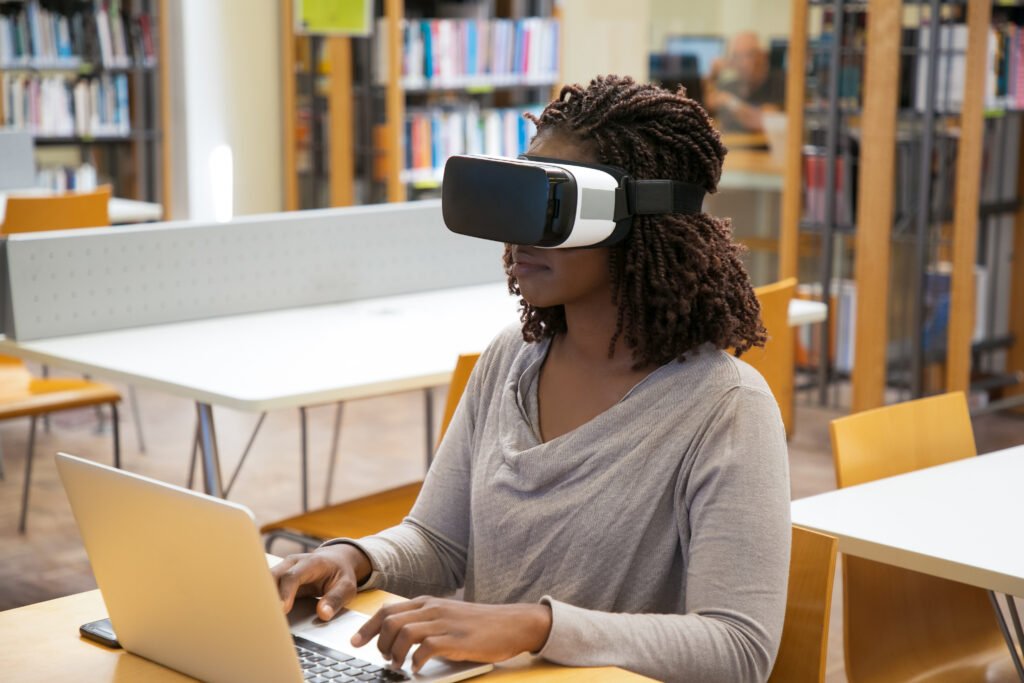
Virtual and Augmented Reality: Learning by Experiencing
VR and AR technology are creating entirely new possibilities for experiential learning that were previously impossible or impractical.
What’s Becoming Possible:
Virtual field trips:
- Walk through ancient Rome as it looked 2,000 years ago
- Explore the inside of a human heart
- Visit the International Space Station
- Dive to the ocean floor to study marine biology
Immersive simulations:
- Medical students practice surgery without risk to patients
- Chemistry students conduct dangerous experiments safely
- History students experience historical events firsthand
- Language learners practice conversations in realistic contexts
Spatial learning:
- Understanding complex 3D structures (molecules, architecture, anatomy)
- Visualizing abstract mathematical concepts in 3D space
- Manipulating virtual objects to understand physics
- Creating and building in virtual environments
Why This Matters:
Traditional education limitations:
- Can’t afford field trips to historical sites or other countries
- Can’t practice dangerous procedures without risk
- Can’t manipulate molecular structures or visit space
- Can’t easily visualize abstract concepts
VR/AR eliminates these limitations:
- Experience anything, anywhere, any time
- Practice unlimited times without consequences
- Manipulate and interact with things impossible in real life
- See abstract concepts made concrete and visual
Real Story: Medical students using VR surgical simulations perform 29% better in actual operating rooms than those who only learned through traditional methods. “I’d practiced that procedure 50 times in VR,” one student explains. “When I did it on an actual patient, my hands already knew what to do. The spatial memory was already built.”
The Immersion Advantage:
Research shows that immersive VR learning:
- Increases retention rates by 75% compared to reading
- Improves understanding of spatial concepts by 40%
- Creates emotional connections to material that enhance memory
- Engages multiple senses, strengthening neural pathways
Real Story: Students learning about the Holocaust through VR experiences of concentration camps showed significantly deeper emotional understanding and retention than students who read about it or watched videos. “Reading about it is one thing,” a student explains. “Standing in that space, even virtually, makes it real in a way words never could.”
Current Limitations:
- Cost: Quality VR headsets are expensive, limiting access
- Technology: Still clunky, can cause motion sickness
- Content: Limited high-quality educational VR experiences available
- Social isolation: VR learning is often solitary
The Bottom Line: VR and AR are beginning to make experiential learning accessible at scale, though we’re still in the early stages of understanding how to use these technologies effectively for education.
The Social Dimension: How Technology Changes Learning Together
Technology isn’t just changing individual learning it’s transforming how we learn from and with each other.
Global Collaborative Learning:
Students can now:
- Work on projects with peers across continents
- Join online study groups with learners worldwide
- Access diverse perspectives from global classmates
- Participate in international competitions and challenges
- Learn from peers in different cultures and contexts
Real Story: High school students in Kenya, Brazil, and Japan collaborated on a climate change research project through video conferencing and shared digital workspaces. “We brought completely different perspectives to the problem,” one student explains. “Technology made it possible for us to learn from each other’s contexts in ways that enriched all of our understanding.”
Peer Learning Platforms:
Students use technology to teach each other:
- YouTube channels where students explain concepts to peers
- Discord servers where learners help each other with homework
- Reddit communities focused on specific subjects
- Study apps that connect learners for mutual support
The shift: Learning is becoming less hierarchical (teacher → student) and more networked (learners ↔ learners ↔ experts).
The Concern: Reduced In Person Social Skills
While technology enables global connection, it may reduce face-to-face social development:
- Students comfortable with online communication but awkward in person
- Reduced experience with conflict resolution, body language reading
- Less practice with spontaneous real world social interaction
- Preference for digital communication even when in person is available
Real Story: College professors report students increasingly email questions rather than attending office hours, text roommates in the next room rather than talking face-to-face, and struggle with in-person presentations despite comfort with video presentations.
The Bottom Line: Technology massively expands who we can learn with and from, but it may come at the cost of developing in-person social and collaborative skills.
The Transformation of Teachers: From Sage to Guide
Technology isn’t replacing teachers it’s fundamentally changing what teachers do and what makes them valuable.
The Traditional Teacher Role:
- Primary source of information and knowledge
- Deliverer of content through lectures
- Evaluator of student work
- Classroom manager and disciplinarian
The Technology-Era Teacher Role:
- Curator of resources and learning experiences
- Guide who helps students navigate information
- Coach who develops thinking skills
- Facilitator of discussions and collaborative learning
- Mentor who provides emotional support and motivation
What Technology Does Better Than Teachers:
- Delivering consistent content to unlimited students
- Providing immediate feedback on routine exercises
- Tracking detailed data on student progress
- Offering infinite patience for repetitive questions
- Personalizing practice to individual needs
What Teachers Do Better Than Technology:
- Recognizing when a student is struggling emotionally
- Inspiring curiosity and passion for learning
- Providing nuanced feedback on complex work
- Facilitating rich discussions and debates
- Building relationships that motivate students
- Recognizing and developing individual potential
- Teaching skills that can’t be automated (creativity, critical thinking, ethics)
Real Story: Math teacher Robert Chen describes his evolution: “Ten years ago, I spent 80% of class time lecturing and 20% helping students with problems. Now students watch my lectures at home, and we spend 100% of class time on discussion, problem-solving, and addressing individual struggles. Technology hasn’t replaced me it’s freed me to do the parts of teaching that are most valuable and that machines can’t do.”
The Skills Gap:
Many teachers were trained for the traditional model and struggle to adapt:
- Feeling threatened by technology rather than seeing it as a tool
- Unclear how to integrate technology meaningfully
- Uncomfortable with diminished authority as sole knowledge source
- Lacking training in facilitation and coaching vs. lecturing
The Bottom Line: The most valuable teachers in the technology era aren’t those who know the most information, but those who develop students’ capacity to think, question, create, and grow. Technology amplifies great teaching but can’t replace it.
What This All Means: The Forever-Changed Learning Landscape
We’re not going back. The transformation of learning through technology is permanent and accelerating.
What’s Clear:
Access has been democratized: Anyone with internet access can learn almost anything Personalization is possible: Technology adapts to individual needs in ways teachers alone cannot Information is abundant: The challenge shifts from accessing information to evaluating it AI changes everything: We must rethink what and how we teach Attention is threatened: Technology both enables and undermines deep learning Teachers’ roles evolve: From information source to guide and mentor
What Remains Uncertain:
Will technology increase or decrease educational equality? It has potential for both Are we raising a generation unable to think deeply? Or one skilled at rapid information synthesis? What should education prioritize when AI can handle routine cognitive tasks? How do we teach in ways that develop human capacities machines can’t replicate?
The Skills That Matter Most:
In a technology saturated learning landscape, what should education prioritize?
Critical thinking: Evaluating information sources, identifying bias, questioning assumptions Creativity: Generating novel ideas beyond pattern recognition Emotional intelligence: Understanding humans in ways machines cannot Adaptability: Learning how to learn as technology constantly changes Ethical reasoning: Making judgments about right and wrong in complex situations Communication: Expressing ideas clearly across mediums and to diverse audiences Collaboration: Working with both humans and AI to solve problems
The Personal Responsibility Shift:
Technology has made learning more accessible but also more self directed. Success increasingly depends on:
- Motivation and self-discipline
- Knowing how to find and evaluate resources
- Managing distractions and maintaining focus
- Taking ownership of your learning path
- Developing metacognitive skills (learning how to learn)
The Bottom Line: Technology hasn’t made learning easier—it’s made different kinds of learning essential. Those who master learning in the technology era will thrive. Those who don’t will struggle increasingly.
How to Thrive in the Technology-Transformed Learning Landscape
So what do you actually do with all this information? How do you learn effectively in this new reality?
Embrace Technology Strategically:
Use AI and technology as tools, not crutches
- Let AI handle first drafts, then add human judgment
- Use technology to access information, but think deeply about it
- Leverage personalization features to optimize your learning
Protect your attention ruthlessly
- Use website blockers during deep learning sessions
- Put phone in another room when studying
- Practice sustained focus on single tasks
- Build tolerance for difficulty and boredom
Develop digital literacy
- Learn to evaluate source credibility
- Understand how algorithms shape what you see
- Recognize bias in online information
- Master effective search strategies
Balance digital and analog learning
- Read physical books to practice sustained attention
- Handwrite notes to improve retention
- Have in person discussions to develop social skills
- Practice skills in real world contexts, not just virtual
Become a self-directed learner
- Take ownership of what and how you learn
- Seek out resources beyond assigned material
- Ask questions and pursue curiosity
- Develop metacognitive awareness of your learning process
For Parents and Educators:
Teach with technology, not just about it
- Integrate technology as a tool for learning, not just content delivery
- Help students develop critical evaluation skills
- Model healthy technology use
- Balance screen time with other activities
Prioritize human development
- Emphasize skills machines can’t replicate
- Create space for creativity and critical thinking
- Develop emotional intelligence and social skills
- Build relationships that motivate learning
Address equity
- Ensure all students have access to technology
- Teach digital literacy explicitly
- Provide support for students without home resources
- Don’t assume all students have equal tech skills
The Future Is Already Here
The transformation is happening now. Technology has already fundamentally changed learning and it will continue evolving rapidly.
The question isn’t whether technology will change education. It already has, permanently.
The question is: how will you adapt to learn, teach, and thrive in this new landscape?
Those who embrace technology’s potential while guarding against its pitfalls will flourish. Those who resist change or uncritically accept all technology will struggle.
The future of learning is personalized, accessible, AI-enhanced, globally connected, and self-directed. It requires new skills, new approaches, and new ways of thinking about what education means.
That future is now. What will you do with it?
Frequently Asked Questions About Technology and Learning
Q: Is technology making students smarter or less intelligent? A: Neither universally. Technology enables access to vastly more information and learning resources, but it may reduce attention spans and deep thinking skills. The net effect depends on how it’s used.
Q: Will AI replace teachers? A: No. AI will change what teachers do shifting from information delivery to facilitation, mentorship, and developing human skills that AI cannot teach. The best teachers will use AI as a tool while focusing on irreplaceable human elements of education.
Q: Should schools ban ChatGPT and other AI tools? A: No. Banning technology students will use throughout their lives doesn’t prepare them for reality. Instead, schools should teach students to use AI ethically and effectively while developing skills AI can’t replicate.
Q: Is online learning as effective as in-person learning? A: It depends. For motivated, self directed learners, online learning can be equally or more effective. For younger students or those needing structure, in-person learning typically produces better outcomes. Hybrid models often work best.
Q: How much screen time is too much for learning? A: Research suggests diminishing returns after 2-3 hours of focused screen based learning daily. Quality matters more than quantity focused, engaged screen time is valuable; passive consumption or distracted multitasking is not.
Q: Will VR and AR replace traditional classrooms? A: Unlikely. VR/AR will supplement traditional learning, providing experiences impossible in physical classrooms. But in-person social interaction and hands-on learning remain valuable and won’t be fully replaced.
Q: Does technology widen or narrow educational inequality? A: Both. Technology can democratize access to quality education for those who have it, but creates new divides between technology-haves and have-nots. The impact depends on whether we ensure equitable access.
Q: Are textbooks becoming obsolete? A: Traditional printed textbooks are declining, but digital textbooks, interactive learning materials, and curated resources are replacing them. The concept of organized learning materials remains important even as the format changes.
Q: How can parents help kids learn effectively with technology? A: Model healthy technology use, teach critical evaluation of online information, enforce boundaries on recreational screen time, ensure access to technology, and balance digital learning with real-world experiences.
Q: What’s the most important skill for students to learn in the technology era? A: How to learn independently. With information and tools constantly changing, the ability to teach yourself new skills, evaluate resources, and adapt to new technologies becomes more valuable than any specific knowledge.
The learning revolution is happening now. The question isn’t whether to embrace technology in education it’s how to harness its power while protecting what makes human learning valuable and irreplaceable.

